
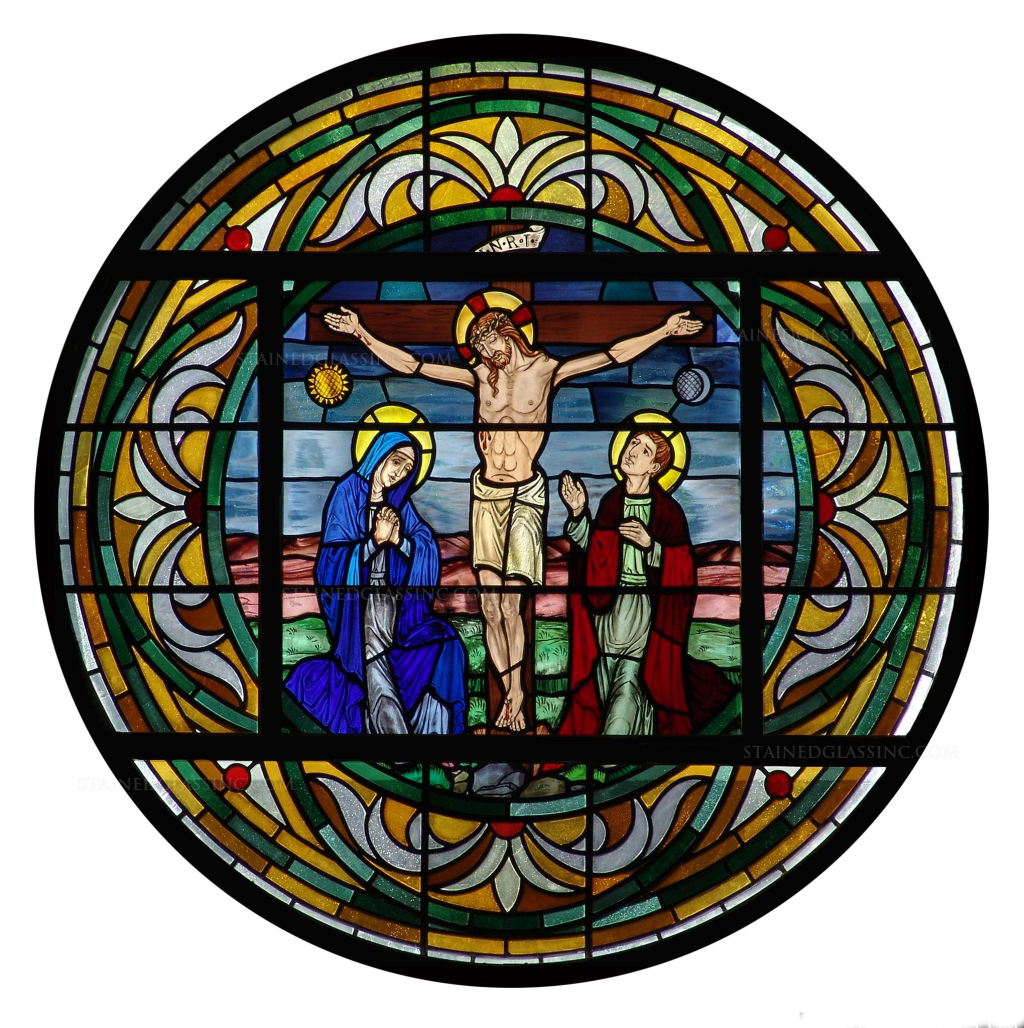
It was now about noon, and darkness came over the whole land until three in the afternoon, while the sun’s light failed, and the curtain of the temple was torn in two. Then Jesus, crying with a loud voice, said, “Father, into your hands I commend my spirit.” Having said this, he breathed his last (Luke 23:44-46).
When our children were small, we wanted to teach them to pray. So after they brushed their teeth and climbed into their beds, after we had read them a story, we wanted them to say their bedtime prayers. The traditional bedtime prayer is this one: “Now I lay me down to sleep; I pray the Lord my soul to keep. If I should die before I wake, I pray the Lord my soul to take.” That tradition is quite deep in the American experience: this prayer was first published, as near as I have been able to find, in the 1784 edition of the New England Primer, which was for about a hundred years the standard workbook for teaching children the basic things they needed to know. Those basic things were two in number, namely reading and theology. (Some people may object that there are more than two things students need to learn, and that’s probably right; but I must say that reading and theology have done well for me. As they say in the car ads, “Your mileage may vary.”)
It is likely that the New England Primer did not originate that prayer: we would expect that some New Englanders were already teaching their children to pray that prayer, and the Primer picked it up and published it so that it would be handy for young parents to have an easy-to-memorize prayer for their children to learn. (By the way, the standard American pronunciation for the word primer, when referring to a brief introductory handbook, rhymes with simmer. When the word refers to the base coat of wall paint, it is pronounced to rhyme with timer. I remember the first time I heard a children’s spelling primer pronounced as primmer, and how I thought the person saying it that way must be mistaken. I was twenty, and was familiar with the word, but I had learned it through reading, and naturally supposed it was pronounced the same way as the first coat of paint. But it turns out that historically, at least since the time of Chaucer, the training book has been pronounced as primmer, but now in England it is pronounced to rhyme with timer, and that is becoming more common in the United States as well. Perhaps, in another few decades, America will have followed suit completely, and the pronunciation primmer will have become obsolete. In the meantime, however, as a fussy language nerd I offer the reader this primmer on how to say this word. I don’t suppose it really matters; if you choose to say it wrong, I will try not to complain. But I will notice it, I suppose because I am primmer than you about such things.)
I think it probably made sense to teach children this prayer, during those decades in colonial America and in the first decades of the nation, when families were large and childhood diseases were so prevalent, and in a family of five or six or seven children, it was quite possible that one of those children had died before the age of five, and if you were a child under the age of 10, you would almost surely have lost one of your playmates from one of the families in the neighborhood. Death could never be ignored. And so as parents taught their children to pray, they would want to teach them to pray regarding death, so that their children would have the confidence that in life and in death, they belonged to the Lord.
But in more recent years, like when our own children were young, my wife and I felt uncomfortable teaching them to pray about life and death every evening. It seemed to us that a prayer that reminded them that they might die before morning, night after night, would perhaps make them more frightened about going to sleep than we wanted them to be. So we found another version of this prayer: “Now I lay me down to sleep. I pray the Lord my soul to keep. Guard me, Jesus, through the night, and wake me with the morning light.”
The point of this prayer is two-fold: experiential and theological. The first is to give our children the opportunity to pray, themselves, out loud: which is often different from the experience of listening to someone else praying. It is a simple prayer, a four line poem with simple rhymes, so it is easy for children to recite it from memory. Some will object that it is not a spontaneous prayer, a prayer emerging in the child’s own words out of that child’s own life. I grant that. Yet I will also notice that not every prayer must be spontaneous. Often we adults find ourselves at a loss for words, and it turns out to be very helpful to have learned a set of words that can be offered as our prayer: as we read one of the Psalms aloud, as we recite a stanza from a favorite hymn, as we remember and repeat a simple prayer we learned as children.
The second point, the theological one, is this. A few years later I had the opportunity to hear singer David LaMotte perform at a Montreat Youth Conference, and he expressed much the same sense of uncertainty about whether the traditional “if I should die before I wake, I pray the Lord my soul to take” wording was what we wanted children to focus on as they got ready to dream their nightly dreams. So he had rewritten the prayer as a song which he titled New Lullaby, and one line of it sings “if the Lord should come see me before I awake, well, we’ll run up to heaven and eat chocolate cake” (You can listen to it on his CD, Flying: Live from the Grey Eagle, 1994). And that’s actually pretty good theology: if we are talking about death, let us talk not only about the reality of grief and loss, but also about it as the transition from the challenges of this life to the glad celebration of eternal life in heaven, where we shall be forever with the Lord. And good rich chocolate cake gives us a fine symbol of that celebration. Yummy, too. The version David LaMotte sang to his son, then, reflects a strong theology of confidence in the grace of God for us, in life and in death. Meanwhile, the version Micaela and I taught our children, with the couplet “Guard me, Jesus through the night, and wake me with the morning light,” helps to give youngsters the sense that Jesus is on watch while we are asleep, and that a new day is coming for us to live as his followers.
The reality is, we live in this world full of life and death, whether or not we want to admit it. And perhaps we dream that we can protect our children from this harsh reality, at least while they are small. That dream is probably not true. It probably never was. At this point in the gospel story, however, it is quite clear that Jesus was no longer a small child, and he was in fact in the midst of this life and death reality, and the last word of our text verse is that Jesus died. The verse uses a specific word to state that Jesus died: it uses the Greek word ἐκπνέω(ekpneo). The New Testament uses this term just three times, twice in Mark and once here in Luke; in all three instances, it is about this moment when Jesus breathed out his last breath. Like many Greek words, it is a compound formed by combining two other words: the word for out and the word for breathe have been joined to form a word that looks like it should mean to exhale, but instead it ended up with the meaning to exhale your last breath. The word pneo is the verb form; the noun form is πνεῦμα(pneuma), a word that does triple duty: it can mean wind or breath or spirit depending on context. So the text says that Jesus breathed his last (NRSV) or perhaps breathed out his spirit, which the King James rendered as gave up the ghost. That’s how they talked back in the 1600s; but nowadays we use the word “ghost” mostly in the spooky Halloween way, so that could be confusing. To help fix that, the New International Version modernizes that just a bit, and says Jesus gave up his spirit. All three translations are endeavoring to render in English this one Greek word, exepneusen, indicating that the wind or breath or spirit of Jesus went out, and therefore he was dead.
You can remember that word pneuma because it’s the root of English words like pneumatic and pneumonia. A pneumatic tire is filled with air or breath, instead of being solid rubber. If you have pneumonia, that means you have trouble with your breath or your wind. And because all three of these English terms are translations of one Greek term, so that wind and breath and spirit are all equivalently possible translations of pneuma, you could have a little fun by doing this. On a brisk March day when you’re out for a walk with your neighbor and the breeze suddenly takes your hat off your head and blows it away down the street, you could turn to your neighbor and say, “Wow, the weather is so much more spiritual today than I expected!” Or when you sit down to Sunday dinner and discuss with the family how worship went that morning, you could say, “The pastor was so windy today,” and everyone would think you were complimenting the quality of the preacher’s devotion.
So over the last few weeks we’ve been looking at the texts in the closing chapters of the four gospels that report to us the things Jesus said from the cross. This is the last of this series of essays, bringing us to the end point of Jesus’ human suffering. And so we might ask, at this point, what kind of day has it been, Jesus? Has it been a chocolate cake kind of day, life is sweet, like a rich rich cake, and then the icing is even better? Has it been a delicious satisfying day like that? No. No, it has not.
So what kind of day has it been, Jesus? Has it been an average day, an ordinary day, a day of solid work, nothing special, nothing spectacular, just an everyday of doing what you do any other day, and at the end of the day you feel tired, even weary, but you know you’ll sleep well tonight and tomorrow you’ll awake to do it all over again, but it’s okay, because that’s the kind of steady reliable person you are? Has it been a solid regular day like that? No. No, it has not.
So what kind of day has it been, Jesus? Has it been an awful, terrible, no good very bad day? Have you been betrayed by a friend, denied by another friend, abandoned by all your other friends? Have you done what you thought was right, what you were sure was the eternal will of God, and now everything has gone to hell, and it hurts, it hurts worse than any pain you’ve ever experienced, and it just keeps on hurting, and you cry out to God Almighty for comfort, for rescue, for solace, and it feels like there’s no one there on the other end of the line, and you can hardly breathe and your tongue is stuck in your dry mouth and you turn once again to your heavenly Father, with whom you have always found comfort and assurance: and there is nothing there, you are cut off from God’s presence, and you knew it was going to happen this way and it is no comfort at all that you knew it would happen this way, and the pain is literally tearing your body apart: has it been that kind of day?
Yes. Yes, it has. It has been the worst kind of day. All the world has turned to agony.
And what would Jesus do, on a day like that? What would Jesus do, in the midst of the fiercest pain inflicted by his enemies, the harshest betrayal and abandonment by his friends, and the absolute emptiness of where his experience of God used to be?
Another year at the Montreat Youth Conference the featured speaker was Carol Bechtel, professor of Old Testament at Western Theological Seminary in Holland, Michigan. During her talk one morning she gave us four letters: W, W, J, D. Our assignment was to figure out what those letters stood for. Over lunch we tried to figure it out. None of us knew the answer, but we had a lot of guesses. As we got back together for the afternoon program, all these youth groups from different churches, from more than twenty different states, all shouted suggestions as to what WWJD might be about. Some of the suggestions were pretty strange. Someone proposed “Western Wyoming Jury Duty.” Someone else called out “Who Was Joe Dimaggio?” A girl from a couple rows in front of us yelled “Willie Wonka Just Dances!” All of them were pretty clever. The one everyone liked the best was, “We Want Jelly Doughnuts.”
But of course you know today what we did not know that summer in 1995: the letters stand for “What Would Jesus Do?” Six months later everyone knew about WWJD, and everyone had bracelets or beads or wristbands with the letters WWJD on them, to serve as a reminder when we were facing some sort of decision, to ask ourselves “What Would Jesus Do?”
As it turns out, the idea of asking What Would Jesus Do has a long and rich history. Thomas à Kempis, a German monk, wrote a series of four instruction manuals during the years 1418 to 1427, which were then gathered into a single volume titled The Imitation of Christ. One of the themes of this book is, if you want to be a follower of Christ, you should be deliberate about following the example of Christ.
The famous 19th century preacher and Bible commentator Charles Spurgeon used the specific phrase “What would Jesus do?” as a sort of refrain in a sermon preached in London in 1881. That same year a Presbyterian minister named A. B. Simpson, who would later become the founder of the Christian & Missionary Alliance denomination, wrote the lyrics for a hymn with the title “What Would Jesus Do?” Nine years after that, a Congregationalist minister in Topeka, Kansas, Rev. Charles Sheldon, began a series of sermon stories at the church’s Sunday evening service. Each sermon was a narrative showing some person facing a moral challenge of some sort. Each one stopped at the moment of decision, when the main character had to choose what to do next: and then these four words: “What would Jesus Do?”
He went on to write a book entitled In His Steps, set in a mythical town called Raymond. There is in Kansas an actual town named Raymond, in Rice County, about the middle of the state, northwest of Hutchinson and east of Great Bend. I’ve been there. It is a small town, now under a hundred residents, down from two hundred or so in the 1950s. Raymond Kansas was founded in 1871, the first town officially established in Rice County. I have been unable to determine whether Charles Sheldon, writing in Topeka in 1896, knew of the town of Raymond, about 200 miles west, or whether he had simply made up the name of the town in his book.
In any case, the city of Raymond described in In His Steps is considerably larger than Raymond, Kansas. It has a college and a railroad company, prosperous suburbs and impoverished slums, factories and mills. The plot centers around Rev. Henry Maxwell, the pastor of First Church of Raymond. He asks his congregation to take on the pledge, for one year, not to take any action without first asking, “What would Jesus do?” Many interesting things transpire after 50 members of his church take that pledge. Again and again difficult decisions are assessed against that standard: “What would Jesus do?”
Yet how does anyone truly know what Jesus would do? There are many situations in contemporary life that are never mentioned in the Bible. What would Jesus do? Who can say, for certain? Henry Maxwell and his flock grapple with this issue, seeking to connect the inner sense of conscience and the prompting of the Holy Spirit: and not only to ponder what Jesus might do, but to go ahead and do what they had discerned.
So in the circumstances of our own lives we can attempt to discern God’s purpose by asking “What would Jesus do?” And in the circumstances of Jesus’ own earthly life we can wonder what would Jesus do. Specifically, we can ponder on the last few moments of Jesus’ earthly life, as he came ever closer to the moment of his own death, and we can wonder what Jesus would do. We can even imagine ourselves in such a situation, being tortured to death by enemies, crying out to God for rescue while knowing that God would not answer that prayer, knowing no rescue was coming: what would we do?
What would you do? What would I do? What would Jesus do? It’s hard to know. It’s a worthy question, but it is hard to answer a speculative question like that with full assurance. It’s often hard even to imagine. So instead of guessing about what Jesus might do, I want to tell you what Jesus actually did. In all that distress, he prayed a simple prayer. He felt the agony of being cut off from God: nevertheless he prayed. He knew that it had been the plan all along that he would be cut off from God the Father; he knew that it had been the plan all along that he would take on the sin of the world, that he would take on the penalty of all the sin of all the world, and would thereby feel the utter absence of the wondrous relationship with the Father that he had up to that moment experienced: and he knew that that would hurt. But my God, my God! How much it hurt! When you are the second person of the Trinity from all eternity you know a lot of things that no human being can know: but when you are a human being in the severest of pain, you are experiencing something that you had never before experienced as the second person of the Trinity. My God, my God! How much it hurt!
And in the midst of all the physical pain of crucifixion, in the midst of all the spiritual pain of the Father’s turning away his face away from his beloved Son, as the judgment of all the sins of all the sinners came crashing down on his soul, Jesus offered a prayer: “Father, into your hands I commend my spirit.”
What does it mean to “commend” your spirit? Like many Greek verbs, the verb here is a compound word, made out of a preposition and a more basic verb. The preposition is para, and means something like “near,” and the basic verb is tithemi, and it means “to put or place” something. So the combination means to put or place something nearby. This compound verb is commonly used to indicate putting food on the table, or to set a teaching in front of someone, or to deposit or entrust someone with money or a valuable object. We should note that the term can be used literally or metaphorically. If I put your supper on a plate on the table in front of you, then I am literally putting something near you. If I set before you a teaching – perhaps by preaching a sermon – who knows, I might take a notion to try that some time – there’s no physical object that is being placed near you: but the word gets used that way. And if I deposit money in your bank, if I entrust my savings to you, there might be literal monetary tokens involved, if I hand the teller a stack of bills, or the money might be entirely conceptual, if it’s an electronic transfer from another institution; but either way, this is the word that might be used.
So when the translators gave us “into your hands I commend my spirit,” they were deciding how to express this word that means, literally, “Father, into your hands I place my spirit near to you.” Or “Father, into your hands I entrust my spirit.”
That is, although he knew that he was cut off from the Father, Jesus nevertheless prayed. And the prayer was a prayer of entrusting himself to God.
There is a great lesson for us all here. In this earthly life we will experience times when we receive no positive feedback in our prayers. Saint John of the Cross called it “the dark night of the soul,” when everything seems empty and useless, when it feels like there is no connection with God at all. Jesus felt like there was no connection with God at all.
Sometimes the way we experience life is just so fine. We feel the love of the people who love us, and we don’t feel anxious about whether we’ll be able to pay the bills; there’s food on the table and we’re giving thanks with grateful hearts. In the midst of good times like that, it’s not hard to feel that the sustaining love of Jesus is quite near. Yes, we get forgetful. Yes, we occasionally take these blessed times for granted. But when all is well, despite our forgetfulness a reminder will come along, giving us the opportunity to recognize that we are indeed so blessed, and our hearts are glad in the Lord.
But it isn’t like that all the time. Some days are hard, and full of worry, and it’s not at all clear that everything is going to work out just fine. Some days God seems far away. Some days we feel the antagonism of our enemies: things are difficult, and they keep getting more difficult, and the harshness of life is leading us deeper and deeper into despair.
Those are the days when we especially need to remember this verse.
Here’s what Jesus did: Jesus remembered this verse. And as he died he quoted it.
Over the course of these essays we have looked at some of the things Jesus said while being crucified. We noted that “My God, my God, why have you forsaken me” is a quote from Psalm 22:1. “I am thirsty” is an allusion to Psalm 63 or 69 or maybe both. And so it should not surprise us to discover that this last word also came from scripture, again from the book of Psalms: Into your hand I commit my spirit; you have redeemed me, O Lord, faithful God (Psalm 31:5).
When the fox chases the rabbit, the rabbit runs fast, it dodges from side to side, it leaps at unexpected angles to make the fox miss: it wants to live. When the car starts to slide out of control on the slick road, when we get the cancer diagnosis, we look for a way to solve this problem: we want to live. But sometimes the rabbit gets caught by the fox, sometimes the skid cannot be corrected, sometimes the cancer is too far advanced, and all that is left to do is die.
And all that was left for Jesus to do was to die.
And yet he prayed. He prayed a prayer that he learned in the Psalms: “into your hands I commend my spirit.” It is out of my hands, Father. I can’t tell if you’re even there: but I put it all in your hands. I entrust or hand over my spirit to you.
There have been times when my experience of the presence of the Lord has been so radiantly vibrantly there for me. There have been times when it has seemed to me that God was not there at all. In those hard and empty times in particular, we need to remember this verse: “into your hands I commend my spirit.”
The Apostle Paul would later write, “In life and in death, we belong to the Lord (Romans 14:8).” Jesus had lived his life with his life in God’s hands, and now he deliberately set his death in God’s hands. In life and in death, we belong to the Lord. That’s true, and it has always been true, but we often live as if it is not true, or as if it is only a little bit true. We often make choices that indicate that we don’t think it’s true, or at least that we only think it’s a little bit true.
But even in his agony, with his very last breath, Jesus affirmed the reality of God’s sovereign care, even though he did not feel God’s presence in this moment: and he said his prayer.
It was not quite the prayer the New England Primer published for young parents to teach their children: “Now I lay me down to sleep. I pray the Lord my soul to keep. If I should die before I wake, I pray the Lord my soul to take.” But it is not very different. That last line – I pray the Lord my soul to take – expresses the same theme that Jesus prayed. “Father, into your hands I entrust my spirit.”
And then Jesus released his spirit: he breathed out his last breath.
Thanks for reading. Feel free to let me know what you think, in the comments.


One response to “Into Your Hands I Commend My Spirit: An essay on Luke 23:45-46”
Thank you. I feel like I just had a long conversation with you, Jay. You enlarged my understanding of this word of Jesus, here a week and a half into the Easter season as I read it. Thank you.
LikeLiked by 1 person