
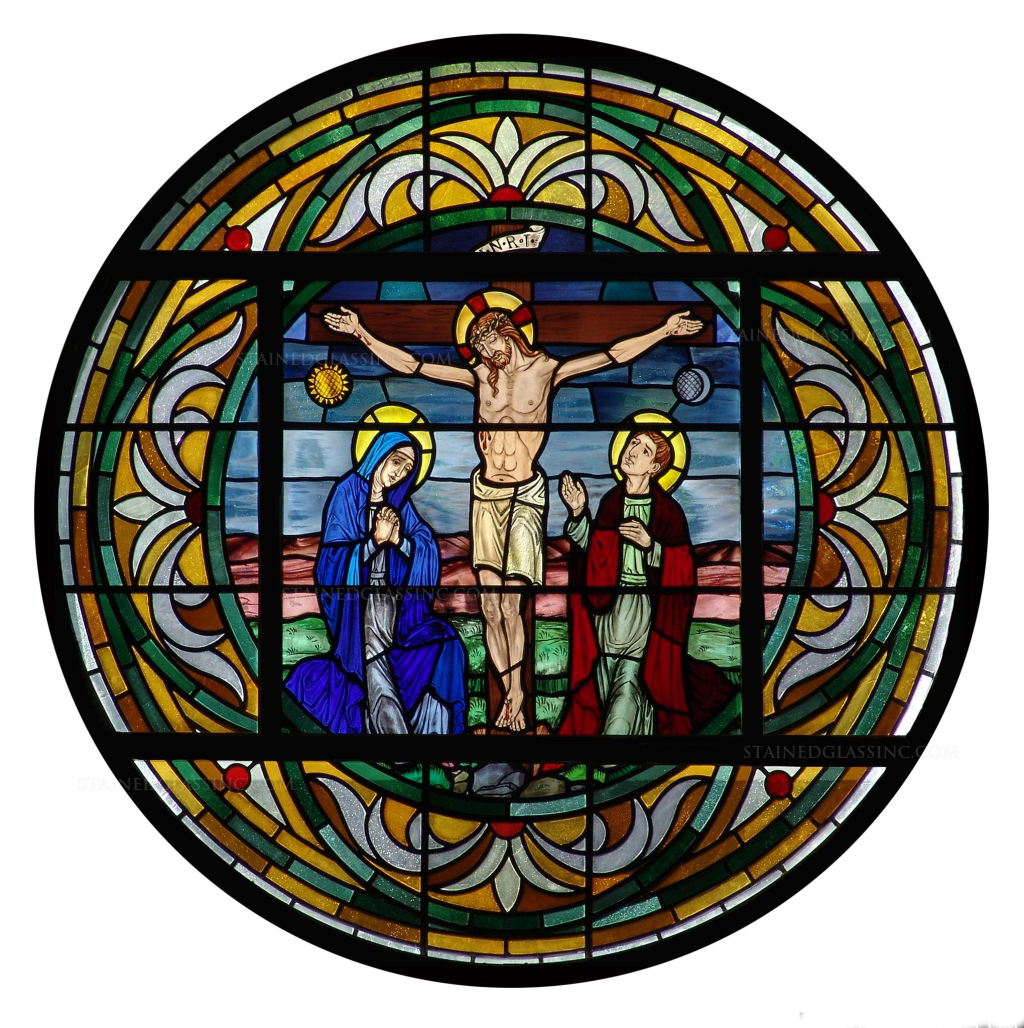
This is the fifth in a series of essays I am presenting on the Wednesdays in Lent, taken from things Jesus said while he was dying on the cross.  These are sometimes called “The Seven Last Words of Jesus,” but that’s probably not the best title for them.  If you find these essays helpful and informative, I’d be grateful if you share the link with friends that might find them interesting.  Feel free to click the [like] button, to write a comment or to ask a question.  And be sure to tap the [subscribe] button, so that you won’t miss out.  Thanks!

After this, when Jesus knew that all was now finished, he said (in order to fulfill the scripture), “I am thirsty” (John 19:28)

Once upon a time, when I was a young pastor in Kansas, we often had Presbytery meetings at First Presbyterian Church of Hutchinson.  It’s a wonderful grand cathedral of a building, all gray stone and woodwork, and every time I walked into the sanctuary there it made my heart want to sing.

One of the matriarchs of that church was a woman named Katheryne Hamilton.  And the real reason many of us came to Presbytery meetings was to see her sing.
Not to hear her sing.  She was a pretty good singer, but not a great voice:  not a soloist, and certainly not an opera singer.  Yet she sang with gusto.  She sang with all her heart.  And – here’s the best part – she sang all the verses:  she sang all the words:  and she never looked at the hymn book.  She knew all the verses by heart.  She knew the famous hymns, like Amazing Grace and How Great Thou Art.  And she could sing all the less well-known ones, too.  I never saw her consult the hymnbook.  I asked some of the other pastors if they had ever seen Katheryne holding a hymnbook to sing the hymns at a Presbytery meeting. No one had.  Well, I thought, we’re not here all that often.  But Bill Soule was the pastor of that church for many years, and one time I asked him if he had ever seen her use a hymnbook.  He nodded his head:  he had.  One time had been six or seven years earlier, he said, and the other time was about ten years before that.

Mark Twain wrote a chapter in Tom Sawyer about memorizing Bible verses, a practice that once was common but now mostly is not.  People would memorize Bible verses, dozens of verses, maybe hundreds of verses, because they loved the Bible, because they wanted to have the words of the Bible firm in their minds, verses learned by heart and living in their heart.  In more recent decades people started to raise the question as to whether that was mere rote memorization, the ability to recite a string of words without much insight or appreciation of the meaning or the application of those words:  surely what we wanted for our children was that deeper grasp on scripture, rather than the shallow parroting of the words?
I get it; that’s a valid concern.  But the results have been – shall we say, less than optimal.  Church leaders and Sunday School teachers said we didn’t want mere recitation of Bible verses:  we wanted appreciation and application of the Bible’s message.  But we have mostly ended up with people knowing neither the biblical words nor the biblical insights.  I think when we memorized verses it sometimes got no further than rote learning; but I think often there was more:  in the process of reading the verse and saying it out loud and practicing it over and over, often that deliberate effort led to serious deliberation about that text’s meaning and application.  By emphasizing learning the lines by heart, we often got both memory and analysis.  By downplaying memorization, we have ended up knowing neither the verses nor the message.

I also imagine that Katheryne Hamilton never set out to memorize all those hymns.  I don’t know for sure; I never recognized, in those days, that I ought to step up and ask her about that.  Still, I have a hard time supposing that she ever said, “This week I’m going to memorize the third stanza of this hymn, and next week I’ll memorize the fourth stanza.”  I think, instead, that when she was a little girl she loved it when the congregation sang the hymns, and she wanted to be part of that; and when she was a teenager she loved singing those hymns with her family and with her church; and when she was a young mother she loved singing those hymns with her children; and on through the decades she loved those hymns and sang those hymns, and it came to pass that she knew those hymns, they were in her heart, they had become part of who she was.

In last week’s essay we saw how Jesus cried from the cross, “My God, my God, why have you abandoned me?”  And we saw that more than one thing was going on in that moment.  We sometimes long for simple answers:  but life is complicated.  Nevertheless, we sometimes want a simple answer, and sometimes we decide that we will only listen to a one-sentence answer, and thereby we sometimes  will reject any explanation that works with the real complexity of a thing:  and that will often lead us into an incomplete grasp on what that thing is all about.

So last week we saw, first of all, the rawness of Jesus’ soul, partly because of the anguish of crucifixion, the Roman way of slowly torturing someone to death:  but mostly because the union with the Father that Jesus had grown to depend on had been severed.  Next we saw that Jesus was quoting the beginning of Psalm 22:  that in the midst of his anguish he brought to mind a song that expressed how he was feeling, because it talked about a man who was being tortured who cried out to God.  Third, we saw that the theme of the song was confidence in God even in the midst of terrible circumstances.  Fourth, then, we saw that Jesus’ question prompts us to consider why it was that the Father turned away from the Son in this event:  for the salvation of the world.  And fifth, we saw that the psalm concludes with the affirmation that the call of the one who suffered would be transformative for the whole world.  All of that comes from recognizing that Jesus used the words of a song he knew and loved in order to express what his soul was undergoing in that moment.

The same thing happens today, with a much shorter quote.  Most of the modern translations make it just three words long:  “I am thirsty.”  The old King James got it done in two words:  “I thirst.”  But in the gospel of John, it’s a single word (διψῶ dipso), because in Greek the verb carries its pronoun with it. Because it’s so brief, it’s a bit of a stretch to say, “It’s a Bible quote!”  Many people have said, “I’m thirsty!” over the years, without thinking they were quoting from the Bible.  But I want to make the case that when John tells us about that single word that Jesus said, he was indeed quoting from the Bible, from the book of Psalms.

I’m going to make the case a little harder for myself, by admitting that I can’t pin down exactly which psalm he was thinking of when he said it.  It could be from Psalm 63.  It could be from Psalm 69.  It could be both.  It is not obvious and exact, because the New Testament is in Greek and the psalms are in Hebrew, and so the way you say something in one language is not quite the same as how you’d say it in another language.  When Psalm 63 says “my soul thirsts,” for example, that’s a good Hebrew idiom; it’s one of the ways you could say “I thirst” or “I am thirsty” in Hebrew.

Here are the first eight verses of Psalm 63:

1 O God, you are my God, I seek you,
    my soul thirsts for you;
my flesh faints for you,
    as in a dry and weary land where there is no water.
2 So I have looked upon you in the sanctuary,
    beholding your power and glory.
3 Because your steadfast love is better than life,
    my lips will praise you.
4 So I will bless you as long as I live;
    I will lift up my hands and call on your name.
5 My soul is satisfied as with a rich feast,
    and my mouth praises you with joyful lips
6 when I think of you on my bed,
    and meditate on you in the watches of the night;
7 for you have been my help,
    and in the shadow of your wings I sing for joy.
8 My soul clings to you;
    your right hand upholds me.

This is another example of the principle we looked at last week, where we saw that when Jesus quoted from Psalm 22, that didn’t mean it’s only about that one verse, it means we need to identify and hear the whole song.  And the same thing happens here:  it’s not just about the single notion of being thirsty, but it’s the first notes of a song, a song that Jesus had sung in worship since he was a small boy, and had long since learned by heart, the way so many people can sing the Gloria or the Doxology by heart, the way Katheryne Hamilton could sing every song in the book, no need to look at the words, the way you can pray the Lord’s Prayer by heart, without needing to read it in the church bulletin.

Jesus had learned a lot of the Old Testament by heart.  Throughout the gospels you can see him quoting scripture, from the Law, from the Prophets, from the Writings.  He had read it, and pondered it,  and memorized quite a lot of it.

I used to think that when Jesus quoted from Psalm 22 while he was dying on the cross, his main focus was on preaching.  His “why has my God forsaken me” was a rhetorical question, he was pointing us to Psalm 22, with just a few words he was preaching us a sermon, even in the midst of his own crucifixion he was pressing to make sure the people standing at the foot of the cross, and the people down the centuries, would understand what was happening:  as the fulfillment of scripture, he was dying for the sins of the world.  I used to think that was the reason Jesus said that.  I still think that it’s an important point, but I no longer think that it is the only point, or even the main point.  I think that Jesus was aware of the rhetorical value of asking “why have you forsaken me.”  I think that in the back of his mind he recognized that quoting that line would help some people see that this was the plan of the Triune Lord:  letting Jesus bear the penalty for the sins of the world so that all the sinners did not have to bear that penalty, but could instead be redeemed.  But I no longer think that was the main thing.  I think the primary thing was singing.  I think the pain of the torture was very severe, and part of how Jesus dealt with that pain was by singing:  a little bit out loud, but mostly in his soul because singing out loud was too hard.

When we were twenty, my wife Micaela and I spent seven months in Ecuador, as short term mission volunteers with Wycliffe Bible Translators.  We lived in the village of Limoncocha, in the eastern jungle, on the Napo River, one of the three major tributaries of the Amazon River.  Micaela ran the dining hall, and I worked the radio, talking to the airplanes that brought supplies to the various missionary translators in the outlying villages.

We worked very hard to avoid getting sick.  The main danger was the water.  We boiled all our drinking water.  We would wash all our vegetables, and then we would cook them.  For raw vegetables – lettuce, tomatoes – we washed them in water with clorox added to it.  The primary parasite that we wanted to avoid was the amoeba.

I remembered amoebas from high school biology class.  They were fascinating.  I had no idea how dangerous they were.  If you get amoebas in you, they multiply rapidly, and they take over your digestive system, resulting in terrible diarrhea and cramps.  The danger is you’ll dehydrate, because you can’t take in water faster than you’re losing it.

Somehow I got some amoebas.  I had a mild case of amoebic dysentery.  We had a couple of missionary nurses in Limoncocha, and they immediately knew what the problem was, and gave me the antibacterial pills that killed the amoebas.
It was a mild case, as I say.  I never want to have a medium case.  With a severe case, you just die, and when you do, you’re glad it’s over.

Memory is a tricky thing.  If I understand the process correctly – and I am not sure that I do – then what I remember is not the actual experience of the pain; instead, what I remember is the recollection of that pain, when the pain had just passed.  When you remember moments of your high school graduation, it’s like you’re seeing those moments all over again.  When you remember a favorite song, it’s like you’re hearing it all over again.  But when I remember that pain, it’s not like I’m feeling it all over again.  It’s like when you are trying to remember your earliest memory from your childhood, and you recognize that you’re not quite sure whether you actually remember that event, or if instead you now remember the story you have always told about your earliest memory.  I think I cannot actually remember the pain itself; I don’t re-feel that pain.  I think what I actually remember is the experience of remembering the pain, when the pain had just passed. What I remember is this:  there was nothing but pain.  When the pain of the intestinal cramp ebbed away, I realized that during the cramp I had had no sensation of vision, not even of light or dark.  No sensation of up or down.  I had no sensation of time:  did the cramp last for a few seconds, or a few minutes, or longer?  I did not know any of these things.  The pain overwhelmed all other sensations.

I’m told that hard labor pains can be like that.  I have never had labor pains, so I have no way of comparing.  All I know is, while it was happening, pain was all there was.  I’m told that crucifixion can be like that, too.  Again, I have no way of comparing.  But when I try to think about the pain Jesus experienced during the crucifixion, that incident in Ecuador is the closest analogy I have, within my own experience.

On that basis, it seems reasonable to me to suppose that when Jesus was experiencing crucifixion, there were moments when he hurt with a hurt that overwhelmed any other feeling.  The divine second person of the Trinity, the eternal Son of the Father, had not had any previous experience with anything like that.  Part of the mystery of omniscience is this:  just because you know everything that can be known, doesn’t mean you can’t learn something new.  We would suppose that as a boy Jesus had sometimes fallen and skinned his knee, and that already was more physical pain than he had ever experienced in an eternity as God the Son.  And that would mean that Jesus, God the Son, thereby learned something that he had not known previously.

Wait!  Consider the mysteries of omniscience and omnipotence.  If God knows everything that can be known, and can do everything that can be done, could God learn something new?

A skinned knee, painful though it is, can be cured fairly quickly with a bandage and a hug.  But death by crucifixion hurts with a pain that is unrelenting.  I expect there would be moments when pain was the only thing he knew.  I suppose during those moments all Jesus could do was groan.  But there were also moments when the pain was severe, yet his mind could struggle to form a thought, to find some hope, to offer a prayer: And in those moments what he reached for was a song.
We saw last week how Jesus reached for Psalm 22.  He did not sing it all with a beautiful voice, so that the bystanders would say, “Wow, that fella can sure sing pretty!”  It probably came out more as a gasp than as a melody.  He apparently did not recite the whole thing out loud:  by the reports given by Matthew and Mark, it appears that he just said the first line:  “My God, my God, why have you forsaken me?”

And I think this is what was happening in today’s reading as well.  He said “I am thirsty,” and I think he said it because he was in fact thirsty.  But I also think he was singing a hymn in his soul.  As I said, it’s hard to be sure which psalm he was singing.  It might have been Psalm 63.  It might have been Psalm 69.  He may well have been remembering both of them, since they both address the theme of thirst.

We tend to think of the psalms as songs of praise, and a lot of Psalm 63 fits that pattern, but Psalm 69 does not fit it at all.  Psalm 63 sings about God’s power and glory and steadfast love, but we should notice that the first verse says, “my soul thirsts for you; my flesh faints for you, as in a dry and weary land where there is no water.”  That’s serious thirst:  that’s hiking a lonely trail for hot miles through a dry and weary land with an empty water bottle, and every time you come to a little creek bed, hoping there might be a little pool of water you can drink from, maybe just a trickle, all you find is dust.  And parched as you are, you must press on under that blazing sky:  you don’t know if there might be water over the next hill, but for sure there’s none here.  Psalm 63 sings about all of God’s good and gracious provision for all our needs, but it also says, “I thirst for you, O God” – with a thirst that is at present not being quenched, but is growing more intense with each breath.
Meanwhile, Psalm 69 says, “I am weary with my crying; my throat is parched.  My eyes grow dim with waiting for my God.”   And it says, “for my thirst they gave me vinegar to drink.”  Here are some selected verses:

3 I am weary with my crying;
    my throat is parched.
My eyes grow dim
    with waiting for my God.
9 It is zeal for your house that has consumed me;
    the insults of those who insult you have fallen on me.
10 When I humbled my soul with fasting,
    they insulted me for doing so.
11 When I made sackcloth my clothing,
    I became a byword to them.
12 I am the subject of gossip for those who sit in the gate,
    and the drunkards make songs about me.
13 But as for me, my prayer is to you, O Lord.
    At an acceptable time, O God,
    in the abundance of your steadfast love, answer me.
With your faithful help 14 rescue me
    from sinking in the mire;
let me be delivered from my enemies
    and from the deep waters.
15 Do not let the flood sweep over me,
    or the deep swallow me up,
    or the Pit close its mouth over me.
16 Answer me, O Lord, for your steadfast love is good;
    according to your abundant mercy, turn to me.
17 Do not hide your face from your servant,
    for I am in distress—make haste to answer me.
18 Draw near to me, redeem me,
    set me free because of my enemies.
19 You know the insults I receive,
    and my shame and dishonor;
    my foes are all known to you.
20 Insults have broken my heart,
    so that I am in despair.
I looked for pity, but there was none;
    and for comforters, but I found none.
21 They gave me poison for food,
    and for my thirst they gave me vinegar to drink (Psalm 69:3, 9-21).

Psalm 69 is a song about someone who is in deep distress, on the point of death, surrounded by enemies.  These enemies mock him:  “I am the subject of gossip for those who sit in the gate, and the drunkards make songs about me. … You know the insults I receive, and my shame and dishonor … Insults have broken my heart, so that I am in despair.”

Psalm 69 is a psalm that prays for rescue:  for deliverance from death at the hand of these enemies.  It uses a variety of imagery for this about-to-happen death:  it pictures the distress as sinking into the mud, or being swept away by a flood, or falling into the pit of hell.  The psalm’s theme is this:  they are killing me; I am about to die; I do not want to die; you alone can rescue me, O Lord; draw near to me, and save me.

And I think that Jesus, on the cross, sweating and bleeding and dying in agony in the hot sun, felt deep thirst.  This thirst was not just a metaphor:  it was actual parched thirst, with dryness in his mouth and no saliva to swallow, with hot raspy breath burning at the back of his throat.  And that thirst might well have made him think of Psalm 69.  It is not a happy song.  It is not a song of praise; instead, it is a lament.  People like happy songs, songs of praise, but in truth we also like sad songs, laments, because we sometimes identify with the sorrow or indeed the bitterness that the song expresses.  I expect that Jesus had sung this song many times, and in the midst of the physical pain of his torture, and his spiritual heartbreak in being cut off from the Father, in the midst of all this distress, this song could have been one of the earworms running through his mind.  Psalm 69 expressed so clearly what he wanted to say, if only he had enough breath to put his anguish into words.

“Answer me, O Lord, for your steadfast love is good; according to your abundant mercy, turn to me.  Do not hide your face from your servant, for I am in distress — make haste to answer me.  Draw near to me, redeem me, set me free because of my enemies” (Psalm 69:16-18).

Yet we know how this story goes.  God the Father does not make haste to rescue Jesus.  The Father has turned his face away, and allows the full penalty of the lostness of the world to land on Jesus.  This is the plan, which God the Son had fully accepted:  to die for the sins of the world.  Yet it is one thing to sit in splendor in the halls of heaven and make the firm decision to step forward to redeem the world by paying the penalty for all the world’s sin:  it is another thing to hang on the cross in agony, feeling the mockery and the hate of the enemies gathered around, feeling the thirst of severe dehydration, feeling the thirst for the presence of God, and finding only a great emptiness where the loving presence of the Father used to be.
So John gives us some editorial commentary:  “It was in order to fulfill the scripture that Jesus said, ‘I thirst’ ” – that is, because Jesus knew that the heart of these two psalms, one a song of praise and one a lament, offered an insight regarding God’s eternal purpose.  This was, I think, one of those times when a person might not recognize what’s happening in the moment when it transpires, but when you look back on it you see clearly what you did not see at the time.  As John later reflected on these words of Jesus, he discerned that there was more going on than what he would have perceived at the time.
We should take a moment to consider what John meant when he said it was to fulfill the scripture. Often people think this means the fulfillment of some prophetic word.  The prophet Joel, for example, offers the word of the Lord pointing to a day when “I will pour out my Spirit on all flesh; your sons and your daughters shall prophesy, your old men shall dream dreams, and your young men shall see visions.  Even on the male and female slaves, in those days I will pour out my Spirit” (Joel 2:28-29).  Then on the day of Pentecost, the Apostle Peter told the gathered throng that “this is what was spoken through the prophet Joel” (Acts 2:16).  That is, here is what the prophet predicted, and now it has happened.  The prophecy has now been fulfilled.

But that isn’t quite what is going on here.  The texts in Psalm 63 and Psalm 69 are not expressed as prophecies about something that is going to happen one day.  They don’t predict some future event; they certainly don’t say “this is what’s going to happen to the Messiah.”  What we have here is more subtle than that.  It is more like a faint echo than a trumpet blast.  We can look at these texts, and at Jesus dying on the cross, and we can recognize that we’ve got an unexpected reminder of Jesus and his death that these psalms of thirst present.  We can recognize that these aren’t just songs that Jesus loved:  they are songs that he identified with.  In his reading, in his singing, in his studying, Jesus had come to know in his soul, “This is about me.”  And John, probably well after the fact, had come to recognize this as well:  and so he points out to us that this is the fulfillment of scripture.  Not the fulfillment of prophecy, but the fulfillment of scripture:  not the completion of a prediction of the future, but the completion of the word that the Spirit of God had spoken to Jesus through these texts and said:  “This is about you, Jesus.”

Sometimes we read a passage of the Bible and it feels only a little interesting, or perhaps quite boring, or maybe completely irrelevant:  and we shrug and go on our way.  Sometimes, instead, we read a passage and it stirs our souls, and we immediately see how it applies within our lives.  That moment of connection, when the Spirit says, “This is about you,” and our hearts respond with recognition that yes, this is about us – Jesus had that same experience, reading these psalms, singing them, learning them by heart, and feeling the sureness that these psalms of thirst, one of praise and one of lament, were about him.  And he did not draw back from them.  He did not shrug them off.  With courage, with fortitude, he accepted that this deep suffering was his calling, his identity, and he embraced it.  He had come to see that this was how the Father would save the world.  And so, for the love of all the lost sinners – the sinners in his own time, the sinners in all the years before Jesus was  born, and all the sinners down the centuries to our present time and beyond – for love of all these troubled souls, Jesus embraced his call to this deep suffering.  As the book of Hebrews points out, he traded in the splendor of heaven in order to endure the cross, despite its shame (Hebrews 12:2).  So John points us to the realization that scripture has been fulfilled, as Jesus bravely sings a few brief notes from these songs of thirst that he has come to know are about him.

We should notice the way that John plays with the rhetoric here, and at the same time we should not let ourselves be dismayed by this.  John says that everything was fulfilled, but not everything was fulfilled yet:  we should ponder on that contrast.  Jesus was on the point of death, and so the principle of “the Messiah dying for the sins of the world” was as good as fulfilled:  everything had been fulfilled.  Except that rhetoric is just a bit premature, because Jesus was dying but not quite dead.  Still, it’s like seeing the dominoes fall:  the last ones in the setup haven’t tipped over yet, but you can plainly see that they will, in just a bit more time.  John recognizes that Jesus had recognized that his death was the fulfillment of the plan for the salvation of the world, and it was about to happen, and there would be no last-second rescue to prevent it.  All was fulfilled.

But not every scripture was fulfilled.  Psalm 63 was not yet fulfilled.  Psalm 69 was not yet fulfilled.   There was more to the purpose of God than had been previously seen.  And as Jesus came closer and closer to the point of death, feeling things that he had never felt before, drawing on the heritage of the psalms of Israel, singing songs in his soul that he no longer had the strength to sing out loud, fulfilling the scripture, Jesus sang, or gasped, or whispered, “I thirst.”  He was thinking of Psalm 63.  He was thinking of Psalm 69.  He felt these songs in his soul:  songs that call on God for rescue.  Songs that call on the presence of God to sustain me when there is nothing else.  Songs that ask for God’s protection in the midst of the danger of death:  don’t let the flood sweep over me, don’t let the deep swallow me, don’t let me fall into the mouth of the Pit.  A song that recognizes at the very same time that I know that I’m going to die, there isn’t going to be some thrilling last minute rescue.  As Jesus lets these songs flow through his mind, the flood is already sweeping over him, the deep is sucking him down, the Pit is open wide.  In these songs of thirst he recognizes that the Messiah shall be utterly cut off, cut off from the people, cut off from God, cut off to die.  The Messiah would be crucified, and the sins of all the world would be laid on him, and he would die.  And the world would be saved.
Next week: It is Finished: an essay on John 19:30.

 james-ayers.com