
an essay on Luke 23:39-43
This is the second in a series of essays coming out every Wednesday in Lent, under the general title “The Last Words of Jesus.” People are often interested in someone’s last words before they die: but as we shall see, the four gospels give us different last words. The situation is a little complicated, but I hope to offer enough explanation for you to gain an understanding of what all these different last words mean. I know that not everyone who reads this will be a Greek geek like me, but I will discuss a bit of vocabulary in the original: printed in Greek, and also transliterated into English letters. All scripture quotations in this essay are taken from the New Revised Standard Version, Updated Edition.
One of the criminals who were hanged there kept deriding him and saying, “Are you not the Messiah? Save yourself and us!” But the other rebuked him, saying, “Do you not fear God, since you are under the same sentence of condemnation? And we indeed have been condemned justly, for we are getting what we deserve for our deeds, but this man has done nothing wrong.” Then he said, “Jesus, remember me when you come into your kingdom.” He replied, “Truly I tell you, today you will be with me in Paradise” (Luke 23:39-43).
Once upon a time there were two men, and they were having a very bad day.
Ordinarily, when I start a story that way, the next thing I would do is tell you the names of these two men. I can tell you that they were the two men who were crucified along with Jesus, but as it turns out, there is great uncertainty as to what their names might have been. Their story is told with varying details in all four of the gospels, but the original New Testament accounts do not give us their names.
There are, however, some names given in several sources from later centuries. There is, for example, a manuscript copied in the 11th or 12th century called Codex Colbertinus, which includes a Latin translation of the gospels of Matthew and Mark. In this codex the men are identified as Zoathan and Chammata in Mark, and as Zoatham and Camma in Matthew.
In Codex Rehdigeranus, a Latin manuscript of the gospel of Luke, copied in the 7th or 8th century, these two get identified as Joathas and Maggatras. There is an Arabic document, the Gospel of the Infancy of the Savior, from the 5th or 6th century, which gives them the names Titus and Dimachus. The Acts of Pilate (a 4th century document, which became quite popular in the middle ages as the Gospel of Nicodemus) calls them Dysmas and Gestas. And the Narrative of Joseph of Arimathea (4th century) only identifies the repentant man, calling him Demas.
Although that may sound like a fairly impressive list of documents, we cannot consider any of these documents to be a reliable historical source, giving us information about the names of these two men. Instead, we have a situation where the earliest records did not give their names, and therefore their names were not known by later writers. And so, at different times and places, various people felt like they had to call them something, and therefore they arbitrarily invented names for them: and those made-up names were added into the legends and incorporated into the texts of various documents.
We may not know their names, but we may feel quite confident about their existence. The four New Testament gospels – Matthew, Mark, Luke, and John – all agree that three men were crucified that day, Jesus and two others. In Matthew those other two are identified as “bandits” (ληστὴς [les-TES]): “two bandits were crucified with him, one on his left and one on his right” (Matthew 27:38); “the bandits who were crucified with him also taunted him” (27:44). Mark is closely parallel, using the same term and giving the same amount of detail: “with him they crucified two bandits, one on his right and one on his left” (Mark 15:27); “those who were crucified with him also taunted him” (15:32).
John gives us no specific indication regarding those who were crucified at the same time as Jesus: they are simply referred to as “others” (ἄλλος AL-los): “There they crucified him, and with him two others, one on either side, with Jesus between them” (John 19:16). Only in John do we read of the necessity to hurry the death of those being executed, so that their bodies would not remain hanging on the sabbath: again, John provides no identifier for these two other than to call them the “first” (πρῶτος [PRO-tos]) and the “other” (ἄλλος). “Then the soldiers came and broke the legs of the first and of the other who had been crucified with him” (John 19:32).
Instead of the rather specific term bandit that Matthew and Mark had used, Luke tells us that these two were criminals, using a more general term, κακοῦργος [ka-KOUR-gos], which literally means “evil doer.” “Two others also, who were criminals, were led away to be put to death with him. When they came to the place that is called The Skull, they crucified Jesus there with the criminals, one on his right and one on his left” (Luke 23:32-33).
As it turns out, before Jesus was arrested, the schedule for that day already called for three men to be executed: these two bandits or evildoers, and also a man named Barabbas.
In John, Barabbas is simply identified as a bandit (ληστὴς). We read that after Pilate had questioned Jesus, he told the crowd, “I find no case against him. But you have a custom that I release someone for you at the Passover. Do you want me to release for you the King of the Jews?” They shouted in reply, “Not this man, but Barabbas!” And then, as is typical of his gospel, John provided a small explanatory comment: “Now Barabbas was a bandit” (John 18:38-40).
Matthew’s account is similar. “Now at the festival the governor was accustomed to release a prisoner (δέσμιος [DES-mi-os]) for the crowd, anyone whom they wanted. At that time they had a notorious prisoner (desmios), called [Jesus] Barabbas. So after they had gathered, Pilate said to them, ‘Whom do you want me to release for you, [Jesus] Barabbas or Jesus who is called the Messiah?’” (Matthew 27:15-17).
Wait. Look again at that word for prisoner: desmios. Is the name Dysmas – you remember, that was one of the proposed names for the two men – is the name Dysmas perhaps a play on that word desmios? It’s an interesting speculation: which is to say, it is a guess. It’s not simply a random guess, pulled out of midair with nothing whatever to support it; but if it is a non-random guess, it is still a guess. We are always free to speculate: and when we do, we must be careful not to mistake our speculations for actual facts. I confess I like the name Dysmas, even though – or maybe because – it has a dismal sound to it. It would be all right with me if that really were the man’s name. But if desmios was the source of that name Dysmas in the 4th-century document called The Acts of Pilate, it would not suggest that the author of The Acts of Pilate actually knew the man’s name and recorded it there for our information. It’s possible that, three centuries after the events in question, a popular legend had arisen that gave the names Dysmas and Gestas to the two men crucified with Jesus, and it’s possible that the author of The Acts of Pilate was familiar with this legend, and thought it provided him with their actual names. On the other hand, it’s equally possible that this author, creating this document and deciding to pin the name The Acts of Pilate on it, decided he ought to provide names for these two men, and so he made up names for them: and called one of them Dysmas, which would sound to people like desmios, prisoner. Which is to say, he gave him with a name that sounded kind of like ‘Prisoner-Guy.”
(Here come two geeky paragraphs that the faint of heart might wish to skip. I’ve written the name of the released prisoner as [Jesus] Barabbas because there are some manuscripts of Matthew that include the word Jesus before the name Barabbas, and some that do not. The name we say in English, Jesus, is the transliteration of the Greek word Ἰησοῦς (Iesous), which is itself a transliteration of the Hebrew יְהוֹשׁוּעַ (Yehosua, or Yeshua). When we transliterate this Hebrew name directly into English, without taking the intermediate step of transliterating it first into Greek, it becomes Joshua. Joshua, successor to Moses as leader of the people of Israel, brought the nation into the Promised Land, and over the centuries many parents named their babies after him. Joshua the Bethsemite (I Samuel 6:14) owned the plot of ground where the Ark of the Covenant arrived, when it was returned by the Philistines. A man named Joshua was governor of Jerusalem in the time of King Josiah (II Kings 23:8). Joshua son of Josedech was high priest in the time when people had returned to Jerusalem from Exile in Babylon (Haggai 1:1ff, Zechariah 3:1ff). When the New Testament writers wanted to talk about someone named Yeshua, they transliterated that to Iesous. Unsurprisingly, nearly all the time, that someone was Jesus of Nazareth. Yet we find among the fellow workers of Paul a man named Jesus Justus (Colossians 4:11).
And perhaps one other New Testament person had the first name of Yeshua: Barabbas. If so, there would have been two prisoners named Jesus: Jesus Barabbas and Jesus of Nazareth. If so, it would make sense for Pilate to ask the gathered crowd which Jesus they wanted clemency for: “Whom do you want me to release for you, Jesus Barabbas or Jesus who is called the Messiah?” On the other hand, it’s possible that an early copyist saw the standard abbreviation of the name Jesus in two letters at the end of the previous word, and concluded that the name Jesus belonged there. There is a decent argument, then, in either direction. Putting the name [Jesus] in square brackets is a way of symbolizing that Barabbas’s first name may have been Jesus, while recognizing that a scribal error may have inserted that name into the text.)
Mark calls Barabbas an insurrectionist (στασιαστής [sta-si-ah–STES], translated as “rebel” in the NRSV), and notes that he was imprisoned along with others for insurrection (στάσις [STA-sis]) and murder (φόνος [PHO-nos]). “Now at the festival [Pilate] used to release a prisoner for them, anyone for whom they asked. Now a man called Barabbas was in prison with the rebels who had committed murder during the insurrection” (Mark 15:6-7).
Luke describes Barabbas in similar language, noting that he had been involved in insurrection (στάσις) and murder (φόνος): Barabbas “was a man who had been put in prison for an insurrection that had taken place in the city, and for murder” (Luke 23:19). A few verses later we read that Pilate “released the man they asked for, the one who had been put in prison for insurrection and murder” (23:25).
What this tells us is that there were three men who were outlaws, from the perspective of the Roman authorities. Perhaps they were part of the party known as the Zealots, who were conspiring to rebel against Roman rule. Perhaps they were part of the group known as Sicarii, literally “dagger men,” a radical faction at the edge of the Zealot party. These men were assassins who kept daggers hidden under their robes, so that they looked like ordinary farmers or workers on a crowded street; when they saw a Roman official making his way across the public square, they could quietly slip in behind the official, stab him, and then quickly merge back into the crowd.
From their own point of view, the Sicarii were freedom fighters, trying to break free from Roman domination. But to the population at large, most of whom were just trying to live their lives from day to day, and certainly within the minds of the Romans, these people were considered bandits, criminals, rebels, insurrectionists, and murderers.
So. Barabbas and his two partners – bandit insurrectionist murderers to the authorities and to most of the common people, but perhaps freedom-fighters to some of the people in the region – had been captured and imprisoned, judged and found guilty, and were now sentenced to be executed by crucifixion. The Jerusalem populace was expecting these three would be put to death on the following day: though one of them might be released, since there was this custom that by public acclamation one condemned prisoner could be set free at Passover.
Suddenly there was a fourth prisoner, Jesus, seized in the middle of the night, beaten by the soldiers who arrested him, tried and condemned before dawn by the religious authorities, and presented in the morning to the governor to be crucified along with the others. Yet for one fortunate prisoner, it could be the day of clemency: Pontius Pilate, the governor, asked whether he should release Jesus. No, the crowd shouted: release Barabbas. The various gospels show Pilate dithering ineffectually in his recognition that the crowd was making the wrong choice; but in the end he acquiesced. Matthew includes the further detail of Pilate symbolically washing his hands of the situation: “he took some water and washed his hands before the crowd, saying, ‘I am innocent of this man’s blood’” (Matthew 27:24). So Barabbas was set free, and Jesus and the other two were led away to be crucified.
Now, as I said, we have no solid means of identifying the two other men who were crucified that day. We are uncertain of their crimes. Perhaps they were merely thieves: that would be a crime deserving punishment, though perhaps not a crime worthy of crucifixion. Or perhaps they were rebels, which makes them heroes or terrorists or assassins or murderers, depending on which side you’re rooting for.
And we don’t know their names. Interestingly, the Roman Catholic Church has latinized the name Dysmas to Dismas, and considers him a saint, as canonized or established by Jesus himself, when he declared “Today you will be with me in paradise.” The feast day of Saint Dismas is March 25. San Dimas, California, is named from the Spanish spelling of Saint Dismas: you may remember it as the home town of the title characters in Bill and Ted’s Excellent Adventure. It is also the original home of Sunkist Oranges. Saint Dismas is considered the patron saint of prisoners, and many prison chapels are named for him.
But let me stress again that nobody today knows the names of the two criminals. There are a lot of candidates: Were they Zoathan and Chammata? Or Zoatham and Camma? I confess to having a certain leaning toward Joathas and Maggatras, because the name Maggatras has the sound of the word maggot in it, and I just have this inner sympathy toward anybody who surely got picked on in fourth grade for having a name that sounds like maggot. And that’s not yet the end of the possibilities. Maybe they were Titus and Dimachus, or Dismas and Gestas. All the sources offer different names: that fact alone makes it obvious that most of those options must be wrong. All of the proposed names come from documents at least three centuries after the crucifixion: that fact makes it very difficult for us to claim that any of the authors actually knew the criminals’ names. Certainly we today do not know their names. So saying that the penitent criminal was named Dismas is entirely arbitrary.
With blissful arbitrariness, then – just like the Catholic Church, and just like the authors of the ancient documents themselves, I have to call them something – I shall call them Dysmas and Gestas. I have no reason other than the sound of the name Dysmas, which sounds like dismal. I had hoped that the Greek name Dysmas might even be the origin of the English word dismal, but it’s not. Dismal comes from 13th century Anglo French, and before that from Old French, and before that from the Medieval Latin dies mal, and it means bad day. If you’re feeling dismal, you’re having a bad day. I expect that Dysmas, the Prisoner-Guy, along with his buddy Gestas, felt like they were having a very bad day, as they were led out of the city to be crucified. It was certainly a dismal fate that awaited them. But I like the name Dysmas, because I envision that some day I may preach a sermon entitled “That Business with Dysmas.” Or – wait a minute – maybe I’ll call it “Christmas with Dysmas.” Both of those have possibilities. We shall see.
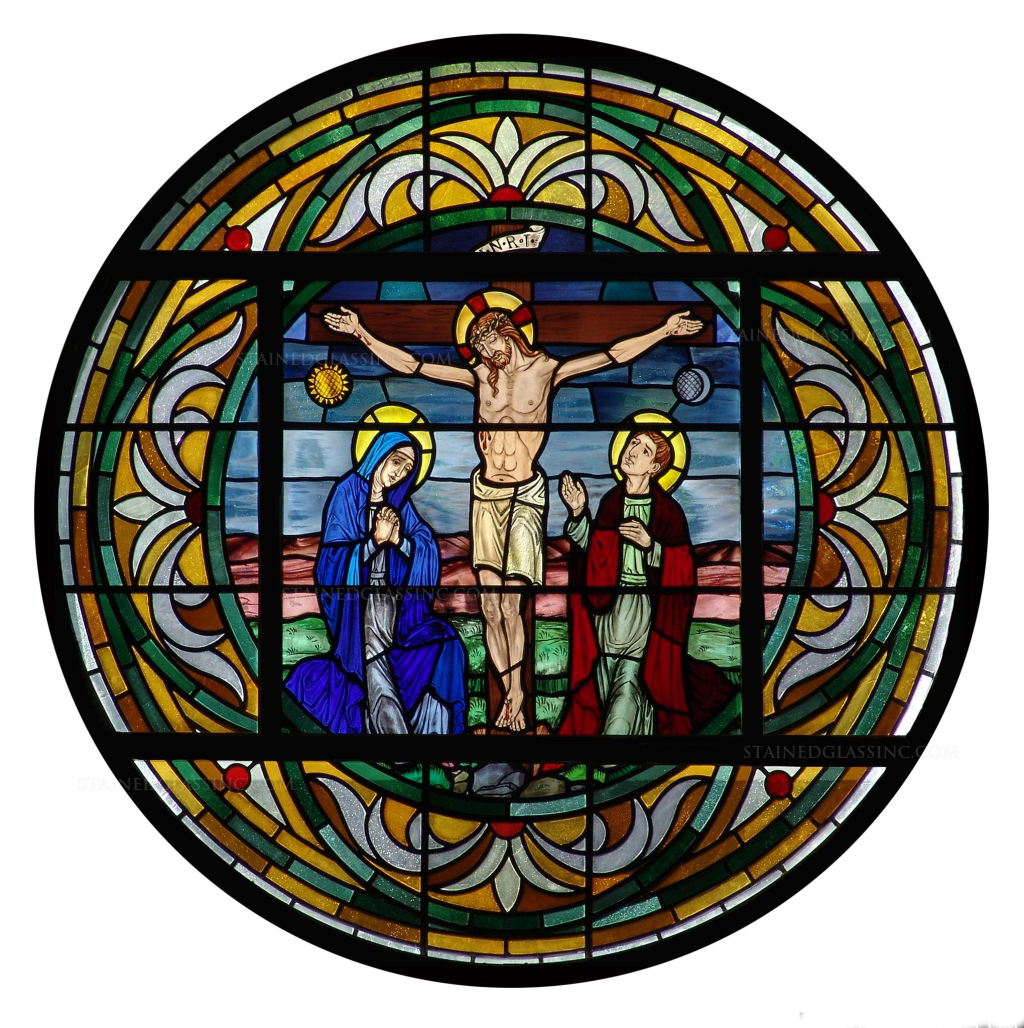
So. Two convicted dagger-men, Dysmas and Gestas, were having a terrible, horrible, no good, very bad day, as the soldiers nailed each of them to a cross and then hung them up in the sky to writhe in agony until they died. And not just them: Jesus, too, was crucified. Everyone was mocking them, although most of the mocking was aimed at Jesus. The officials were mocking him: just a few days ago, everyone had been hailing Jesus as a king, and now here he was, naked and bleeding and gasping for breath. The crowds and the soldiers joined in, with jeering and name-calling, yelling that if he was so almighty powerful, he ought to just take himself down from the cross. Matthew and Mark suggest that the two bandits joined in on mocking Jesus. John doesn’t report that the two others said anything at all, to each other or to Jesus or anyone else.
But Luke tells us that one of them – Gestas, we shall say – proposed that if Jesus were the Messiah, he ought indeed to save himself, and while he was at it, Jesus ought to save Gestas and Dysmas, too.
And Dysmas spoke up, and rebuked Gestas. “Do you not fear God, since you are under the same sentence of condemnation? And we indeed have been condemned justly, for we are getting what we deserve for our deeds, but hehas done nothing wrong.” (Luke 23:40-41).
Then he said, “Jesus, remember me, when you come into your kingdom” (23:42). That’s such an evocative request, isn’t it: Jesus, remember me, when you come into your kingdom.
How much would we suppose Dysmas understood about Jesus? We could guess that it wouldn’t be much: we might suppose that most assassins don’t make a habit of going to religious revival meetings. But then again, Jesus had become fairly well-known, for his teaching and his miracles. Dysmas may have heard some stories about Jesus: some stories that gave him the thought that Jesus would come into his kingdom. And yet, there is a strangeness to this idea. It’s like, we’re all three being crucified here. It’s the end of the road for us, and indeed a very unpleasant ending: we’re all bleeding and broken and dying, right now, and soon the three of us will be dead.
And yet, after we’re all done dying today, Jesus, when you then come into your kingdom, please remember me.
Perhaps Dysmas had heard more snippets of reports regarding Jesus than we might have expected. Perhaps he had heard that Jesus had been sent by the Father for the redemption of the world. Perhaps he had heard that Jesus had said that when he was lifted up in crucifixion, he would draw all the world to himself. Perhaps Dysmas understood that Jesus was going to heaven to be with the Father, and hoped that when Jesus did that, he could take Dysmas with him. Sometimes you don’t know everything you need to know, but you have heard a little bit, and you have paid attention to that information, and you have pondered on what you learned. Perhaps Dysmas had heard something about Jesus, and paid attention and pondered, and so he was ready to offer his prayer: “Jesus, remember me, when you come into your kingdom.”
It is a prayer. I’ve repeated it several times, now. If you’ve been paying attention and pondering, you might well have thought of another prayer that we sometimes pray, a prayer with the line “Thy kingdom come” embedded within it. Perhaps Dysmas had heard enough snippets of the teaching of Jesus to glean something of the coming kingdom.
Or perhaps not. Perhaps it was simply a recognition, amidst the raw pain of that moment, that somehow, somehow, the death of the Messiah was at that very moment opening the gate to the kingdom of God for all this suffering world. And so in the midst of his own pain, Dysmas offered up his prayer: “Jesus, remember me, when you come into your kingdom.”
We should note that this is not one of the prayers that we commonly think of. It is not a prayer of “inviting Jesus into your heart.” I will happily affirm the worthiness of inviting Jesus into your heart, which is after all an application drawn from scripture, from the book of Revelation, where Jesus tells the church in the town of Laodicea that he stands at the door, knocking, awaiting the invitation to come in and sit down and dine with them (Revelation 3:20). I simply want to recognize that that was not this man’s prayer. His prayer is short, but heartfelt: Remember me.
And Jesus answers that prayer. He answers it with the specific affirmation: “Truly I tell you, today you will be with me in paradise” (Luke 23:43).
There are a couple of challenges within this response: the word today and the word paradise. Could it really be today, and could it really be paradise, if in fact they are dying right then on Friday afternoon, but the resurrection will not be till Sunday morning?
I want to say a couple of things about that. First, we should note that it is probably not a good idea to try to figure out chronology or geography based on this verse. There just isn’t enough information in this verse to do that. It would have been okay with me if Jesus had explained himself in more detail, but he was busy dying in agony right then, and I have seen enough situations where someone is in serious pain, whereby I have learned that people generally won’t give you three carefully researched and outlined paragraphs of theological explanation at a moment like that.
And second, in a situation where two men are conversing with each other, gasping because of the pain and gasping because they can’t breathe, it makes sense to sum up the reality as “Today you will be with me in paradise.”
We should notice that there is a phrase connecting the today and the in paradise in this sentence, and this connecting phrase is the heart of the sentence: you will be with me. The answer to all of this is, you will be with me. The resolution of this horrible death, the redemption of your sinful life as a robber or insurrectionist or dagger-man, the answer to your prayer to be remembered, is this: you will be with me.
More than that: it will be a present lived reality, it will be your own conscious experience. You will be with me, which is to say you and I will be together. People sometimes think that when you are dead, you have some faint continuing ghostly consciousness, in which you can remember something of what your life was like when you used to have a life: but you will be with me, says Jesus, and it won’t be like some vague drifty memory: it will be genuine and clear. Other people sometimes think that when you’re dead, you have some faint dreamy awareness that in some unimaginable future things will somehow work out: but it won’t be like that, either, says Jesus, when you are with me. Instead, it will be a present experienced Now reality. It will be an experience of Today-ness. And so in the midst of this very bad day, this man goes to his death knowing that he will be with Jesus: the presence of Jesus will sustain him, even as he dies. As Paul would later write, “Whether we live or whether we die, we belong to the Lord” (Romans 14:8).
We could stop here, but there are two more things to say. The first is an important emotional point: we can feel some sympathy for Dysmas as he prays, “Jesus, remember me.” His prayer reveals his anxiety as he dies: “I’m not sure if I will be remembered. I fear that I will just be gone, forgotten. I’ll be dead, and no one will remember me. Jesus, remember me.” To which Jesus’ response is a cry of exultant assurance: “Remember you!? You’ll be right there with me! We’ll be there in the kingdom together!”
The second is an important theological point: The prayer of Dysmas, “Remember me when you come into your kingdom,” is a recognition that an immense thing is happening here. As Jesus was being crucified, the onlookers said, “He saved others, let him save himself, if he is the chosen Messiah of God” (Luke 23:35). The soldiers said, “If you are the King of the Jews, save yourself” (23:37). The other criminal cried out, “Are you not the Messiah? Save yourself and us!” (23:39). It is all presented as a mocking jeer, and yet it points us toward an important realization: Jesus saves.
It is integral to the identity of the Messiah that he saves. It is obvious to everyone there that if Jesus is the Messiah, he can certainly save himself from the fate of death by crucifixion. The onlookers specifically recognize that Jesus has saved others: he has given sight to the blind, he has enabled the crippled to walk, he has healed the sick, he has fed the hungry, he has raised the dead: and he has declared forgiveness to ever so many sinners. He has already saved a lot of people.
If Jesus is the Christ, he can save himself from death. While you’re at it, Gestas proposes, you could save us from death, too.
But Jesus will not save himself from death, because the Messiah has come not simply to save a few people, or a few thousand people: he has come to save the world. The Messiah has come not simply to save the people from that particular time and place: he has come to save the world of his day, and of the preceding years, and all the years to come, down to our present day and on into the future. The Messiah has come not simply to save certain people from medical issues, or to feed a multitude of hungry people: he has come to save the world from sin and death. And the Messiah saves by dying. We will look at why that is, in the coming weeks; but it is true that to accomplish his task, the Messiah must die. And so he will.
And so we pray, “Jesus, remember me, when you come into your kingdom.” And he answers, “Let me tell you truly: today is the day of the kingdom right now. And you will be with me, in the kingdom of God – in the paradise of the kingdom of God! – forever.”
Believe it, children of God: believe it.
Next week: ”Here is your son. Here is your mother.“

 james-ayers.com