
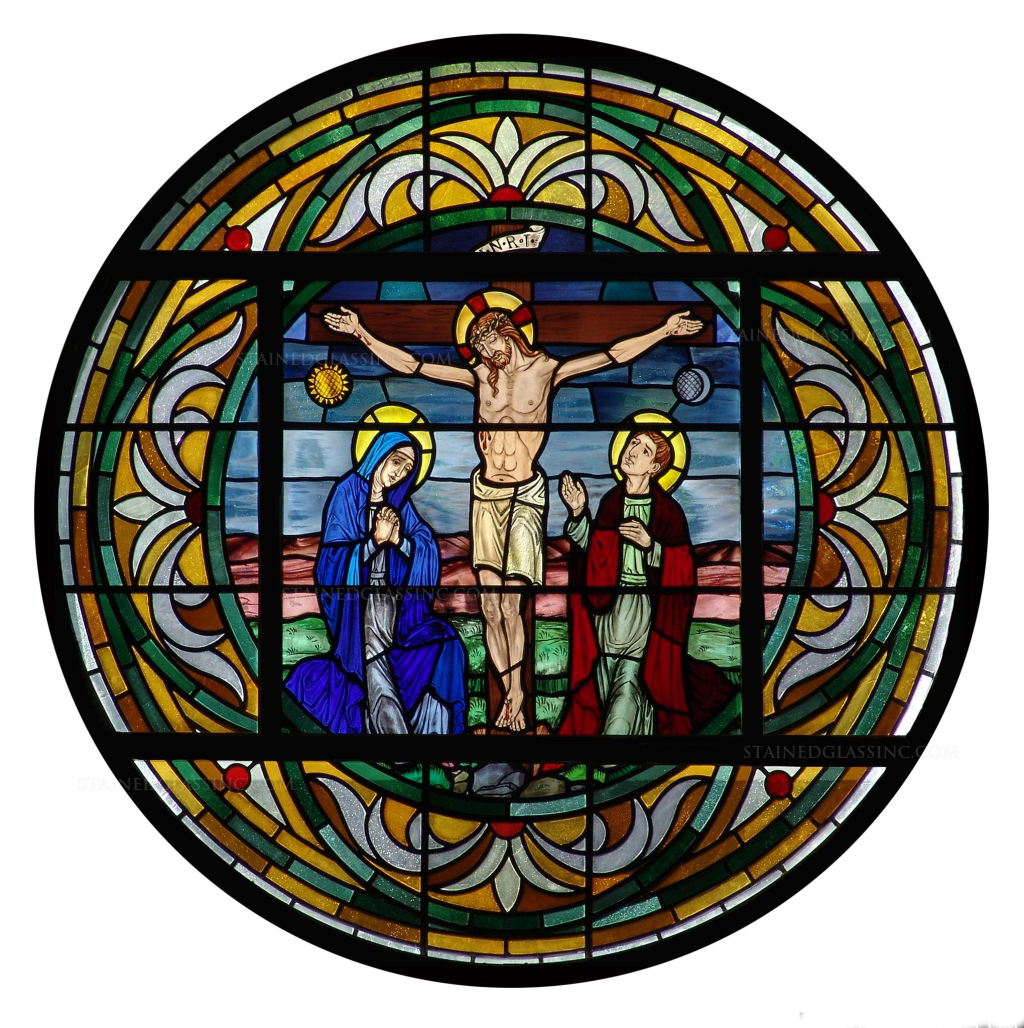
This is the first in a series of essays I plan to publish every Wednesday in Lent, under the general title “The Last Words of Jesus.” That’s an odd notion, isn’t it? Doesn’t Jesus continue to speak to the church even today? Nevertheless, traditionally there are seven sayings of Jesus, spoken while he was dying on the cross, and people often refer to these seven sayings as the “Seven Last Words.” Most of these sayings are more than one word long; the Seven Last Words include quite a lot more than seven words. And, as we shall see, there may not be precisely seven of these sayings.
Two others also, who were criminals, were led away to be put to death with him. When they came to the place that is called The Skull, they crucified Jesus there with the criminals, one on his right and one on his left. Then Jesus said, “Father, forgive them; for they do not know what they are doing.” And they cast lots to divide his clothing. And the people stood by, watching; but the leaders scoffed at him, saying, “He saved others; let him save himself if he is the Messiah of God, his chosen one!” The soldiers also mocked him, coming up and offering him sour wine, and saying, “If you are the King of the Jews, save yourself!” There was also an inscription over him, “This is the King of the Jews” (Luke 23:32-38 NRSV).
Once upon a time there were two fellows out hiking, and they saw a bear. It was a grizzly bear, a mama grizzly bear, and I suppose I should warn you that this could be a grizzly tale. The bear was several hundred yards away. She was sharpening her claws on a tree trunk. She caught the scent of the two hikers, and turned and looked at them. The bear started ambling in their direction. The two hikers started walking away. The bear kept coming; not fast, but steadily. One of the guys sat down and dropped his knapsack off his shoulders. He grabbed his sneakers out of the pack, and quick as he could he unlaced his hiking boots and pulled on his sneakers instead.
His friend said, “What are you doing that for? You know you can’t run faster than a bear.”
And the first guy said, “I know. But I don’t have to run faster than the bear. I just have to run faster than you.”
Once upon another time there was a fellow who was out hiking by himself, and he saw a bear. It was a young bear cub, and it was so cute! He thought, “I’m going to get a picture of that cute baby bear.” So he walked closer, nice and slow, didn’t want to scare the little guy. He pulled out his phone and took a picture. He looked at the picture and thought, “I need to get closer.” So he walked closer, and took another photo. It looked pretty good. And he thought, “What would be really cool would be to get a selfie with that bear cub.” So he walked right up to the cub, and squatted down next to the cub, and took a selfie.
It turned out to be a great selfie. It was such a fine close-up of the hiker and the cub, and in the background you could see the mama bear charging in, with one paw upraised to take the hiker’s head off. It turns out that you don’t want to get between a mama bear and her baby bear. You will feel the furious protectiveness of the mama bear coming down on you like the wrath of God. But you probably will not feel it for long.
Once upon a time – a time that was about 27 centuries ago – there were two prophets whose names were so similar people today sometimes get them confused: first Elijah, the more famous and fiery of the two; and then Elisha, a young man who became Elijah’s servant, and student, and eventually his successor. The prophet Elisha was quieter in personality than his teacher. The stories about him are mostly about helping people in quiet compassionate ways, rather than confrontations with kings about the evil practices of a nation.
But there is a story in the second book of Kings about the prophet Elisha, after Elijah had been lifted up to heaven and Elisha had become the prophet of Israel. One day he was on his way up to Bethel, the narrative tells us, where the shrine of the northern kingdom was. As he was on the road, a large number of boys came out of the town and started taunting him about his travel to the shrine, and about his baldness. Here is what the text says:
He went up from there to Bethel, and while he was going up on the way, some small boys came out of the city and jeered at him, saying, “Go up, you baldhead! Go up, you baldhead!” And he turned around, and when he saw them, he cursed them in the name of the Lord. And two she-bears came out of the woods and tore forty-two of the boys. From there he went on to Mount Carmel, and from there he returned to Samaria (II Kings 2:23-25, NRSV).
What would you think, if you were walking along the road, and a group of about fifty boys came running toward you, yelling at you, mocking you? If this were a couple of kindergarten classes out for recess, maybe you wouldn’t think much about it. It would be annoying, for sure, but you wouldn’t be much afraid of boys who were five or six years old, even if they were making rude comments about your hair loss. On the other hand, if these boys were in their late teenage years, and there were four dozen of them, making fun of you, calling you names, you might feel a mite anxious about what they wanted.
Elisha the prophet cursed them in the name of the Lord. I don’t know if that’s what he should have done. But the narrative says that’s what he did. And then – oh my. The text says that two female bears came out of the woods, and ripped through those boys. Ripped through those poor innocent tots, if you think of them as six-year-olds. Or ripped through that horde of street hoods, if you think of them as a gang of teenage toughs.
The Hebrew word used there, naʿar, is used to talk about Samson as a newborn baby, and Samuel as a boy growing up as a student of Eli the high priest. It is the word used to describe Joseph, in prison in Egypt, when he was about 30 years old. It is also the term used to identify the harvest workers in Boaz’s fields, and to describe teenage David, getting ready to fight Goliath. Soldiers in the army of David get called by this term, as do a troop of 400 soldiers in the Amalekite army. So if we divide the world into two categories, the young and the old, this word naʿar is the generic term for “the young.”
That’s quite a range of ages: from newborn to age 30, or 35, or 40, wherever the line is between “the young” and “the old.” Yet in English we follow the same pattern. We use one word, boy, to talk about a college boy or to say regarding a newborn, “It’s a boy!” How old are the boys in the band, when KISS sings to Beth that “me and the boys will be playing all night” – mid-twenties? mid thirties? They’re clearly older than teenagers.
But we should note that the Hebrew text also includes the term qāṭān, which is a word that means small or insignificant or young. When the Ninevites repented, they fasted and put on sackcloth, from the greatest to the least (Jonah 3:5). This doesn’t mean from the tallest to the smallest, nor does it mean from the oldest to the youngest. It means the range between the king and the nobles before whom you must bow, on the one hand, and the insignificant peasants, on the other hand. The psalmist sings that God “will bless those who fear the Lord, both small and great” (Psalm 115:13). Again, this is not everyone, no matter how short or tall, no matter how young or old: it means everyone from the royalty to the rabble. This same usage shows up in Jeremiah (6:13, 31:34): “the least and the greatest” refer not to height or age, but to social status.
Many English translations (KJV, ESV, NASB, ASV, NRSV) say “young boys” or “little boys” came out from the town to taunt Elisha. Others (NIV, NKJV, CEV, GNB) say simply “boys” or “youths.” The International Standard Version renders the combination of naʿar and qāṭān as “insignificant young men.” I would propose that we can’t really tell, just from the words, whether it’s five-year-olds running around playing, or teenage boys or twenty-somethings who had formed a street gang.
But I have a hunch.
I can see that Elisha might have felt quite threatened by a gang of fifty rough teenagers coming at him, and might have called down a mama-bear curse on them. As I said earlier, I’m not sure that that was the right thing to do. But I do know that aiming for the destruction of little kids would never be the right thing to do. Just as no one can approve of someone taking an assault rifle to kill a kindergarten class, so also no one can approve of calling on the wrath of God to wipe out little children. So I think we should see this as rough young men looking like they were about to mob Elisha. You are welcome to disagree. As I said, the terms the text uses don’t quite specify the age of the boys in this crowd.
Meanwhile, the text does specify that the bears were female. They were mama bears. And these mama bears had it in their heads that Elisha was the cub they were supposed to protect. The mama bears were the wrath of God, coming down on those boys. The text says that 42 of these fellows were wounded by these two mama bears. They could not run faster than the bears. I assume that a few of the boys got away unscathed. They didn’t have to run faster than the bears; they just had to run faster than the other boys.
This series on “The Last Words of Jesus” will look at the traditional Seven Last Words – seven last sayings, really – that Jesus spoke while he was on the cross. Today we look at the first of these sayings, “Father, forgive them, for they do not know what they are doing.” And perhaps the first thing we need to take note of is the uncertainty about the text of Luke right here. If you read that verse, Luke 23:34, in most modern translations, there will be some kind of notation – brackets around it, a footnote about it, or omitting it from the main body of the passage and placing it at the bottom of the page within a footnote – some way of indicating that the evidence is strong that this line was not in the original text of Luke.
Some of you youngsters might not believe it, but once upon a time there were no photocopiers, no scanners or computers or laser printers, and so any time you wanted a copy of something, it had to be copied by hand. I know, I know: “you kids get off my lawn.” But really, there was a science to it: it was not like taking notes in class, frantic scribbling. Instead, there was a deliberate procedure for the careful way you formed each letter, a method of keeping track of where you were on the page you were copying from, called the source manuscript. There was a process for double-checking your work in the manuscript you were making, called the target manuscript. You were aiming to provide a perfect copy of the source manuscript. Because they revered this text as the Word of God, the scribes who labored at this task were exceptionally careful in their work.
Still, they were human. They got tired. They got distracted. After an hour or two of concentrated copying your attentiveness starts to fade, and you’re thinking about how the weather has been cold and you need to order another load of firewood, or you’re thinking about guests who are coming to visit this weekend and what should you feed them. And so for a moment you’re not careful, and your eye goes to the wrong place in the source manuscript, and you inadvertently leave out a whole sentence. Or you read a whole sentence in the source manuscript and then copy the whole thing down: but you misremember one of the words, or you reverse the order of two of the words, writing what you thought it said instead of what it actually said. People make mistakes. The scribes who copied manuscripts of the Bible worked very hard to ensure their work was flawless; they did astonishingly well; but they were not perfect.
In Studies in the Theory and Method of New Testament Textual Criticism, the late New Testament scholar Gordon Fee provides documentation for 5,350 manuscripts of New Testament writings from the first eight centuries that have survived to the present day. Some of these manuscripts are complete New Testaments; some of them are one or several gospels or letters; some of them are damaged, so that not all of the document can be read; some of them are fragments, where a small portion of a single page is all that remains. There are, in addition, thousands of early quotations included in the writings of early Christian authors such as Augustine and Chrysostom. This wealth of documents makes it possible for scholars to weigh the evidence for one variant or another, and thereby to determine the original text of the New Testament with very high accuracy. And so if you read a modern translation of the New Testament, you can be confident that the translators were working from this carefully developed critical text that contains, with very high accuracy, the original Greek wording of every book of the New Testament.
I confess, I love this nerdy stuff about ancient copies of the New Testament. I also recognize that most people do not. Maybe including you. Nevertheless I have taken a few moments to walk through this to make this point: the evidence from all these manuscripts strongly suggests that when Luke wrote the first edition of the narrative we now call “The Gospel of Luke,” he did not include these words: “Father, forgive them, for they don’t know what they are doing.” Nevertheless, the consensus of the scholars is that the words probably do belong there, because of the high likelihood that they were indeed spoken by Jesus, and that these words were added into the text of a very early copy made by an unknown scribe, probably late in the first century, who had heard teachers say that Jesus had said this, when he was on the cross: “Father, forgive them, for they don’t know what they are doing.” And so this unknown scribe corrected the manuscript, adding in the words that he was sure were supposed to be there. By the second century there were scribes making copies of the first edition of Luke and scribes making copies of the second edition of Luke, and they were almost identical: but some of them had this saying in them and some did not.
All right. As I said, that’s probably more technical detail than you wanted to know. But if we have high reverence for the teaching of the New Testament, we need to reckon with the reality of what our present-day New Testament actually is: an effort to transmit, as accurately as people could manage, the words of the original authors of the twenty-seven books that make up the New Testament. And when preachers stand up on Sunday morning to teach “the meaning of the Bible” to the gathered congregation, it is our duty to help people understand what the Bible actually says, and how it says it, and what that means for our lives today.
So, the majority of scholars tell us that this saying was not in the first edition of Luke; in the second edition it was a correction, adding in these words of Jesus; and among the many manuscripts and citations that scholars get to work with, the very earliest ones that have come down to us don’t have these words. And yet maybe this verse gives us the very words of Jesus, which means that these words comprise the first of these “Seven Last Words of Jesus.”
If these words are genuine – I think they are, but if you feel more skeptical, I won’t fight with you about that – if these words are a genuine saying of Jesus, spoken from the cross, what do they mean?
They mean that Jesus was thinking about the wrath of God.
As God the Father watched from heaven and saw his Son being mocked and beaten and insulted and stripped naked and nailed to the cross and hung up in public so that everyone could watch him, and jeer at him, as he died in slow agony, how would God the Father feel about that? We may recall that God loved the world so much that he sent his only begotten Son to die: so watching as God the Son died was something that God the Father had had in mind long before God the Son took on human flesh and was born as a child of this earth.
But here’s something to ponder on: there’s a difference between thinking about a thing and experiencing a thing. For example, there’s a difference between thinking about diving for the first time from the ten meter platform, and standing at the edge of the ten meter platform looking down at the water before you dive for the first time. In his classic novel The Red Badge of Courage, Stephen Crane shows us the difference for young soldiers between thinking about going into battle for the first time, and actually marching onto the battlefield while the enemy is shooting at you. There’s a difference between thinking about a thing and experiencing that thing. Jesus had thought about how he was going to die on the cross for the sins of the world, but it turns out that experiencing the process of dying by crucifixion is different from thinking about crucifixion.
And so Jesus recognized that just as the reality of being tortured to death was happening to him – not just the idea, but the reality – so also something was happening to God the Father. God the Father was watching his beloved Son get tortured to death – not just the idea, but the reality of this. It’s one thing, to think about something, to mull over the idea of it; it’s another thing, to experience the reality.
The Father was watching these people torture his beloved Son to death.
It is a hard thing, to watch the suffering of someone you love. At a moment like that, you are ready to do anything within your power to fix that situation. Often there is not anything at all that you can do. But if there were, you would be ready: ready to break down the door, ready to fight the fight, ready to run into the flames, ready to commit all your strength to stop the pain. If you had the power, you would use it.
Yet lack of power is not an issue for God. So what would God the Father Almighty do, as he saw these people torture his beloved Son to death?
What would a mama bear do, if she saw someone endangering her cub? She would attack like the wrath of God. The text in II Kings doesn’t say how many of those young toughs there were in the Bethel street gang; it only tells us how many got injured by the mama bears. As I said, I’m guessing that there were about fifty of them, and forty-two ended up with injuries, and a few of them who got away unscathed. But it would be different, when the wrath of God came down on the people crucifying Jesus there. No one was going to be able to run fast enough to get away. The wrath of God would cut through them all, like the fury of a mama bear, like the fury of ten thousand legions of mama bears. Not one of the people crucifying Jesus would escape. They would all get ripped apart.
But they didn’t get ripped apart.
Because Jesus interceded for them: “Father, forgive them, for they do not know what they are doing.”
Sometimes you don’t realize that what you are doing is wrong. Sometimes you don’t realize that what you are doing will have consequences, bad consequences, terrible consequences. Terrible consequences for others, and terrible consequences for yourself. Sometimes you don’t realize that what you are doing could wreck your world, when the wrath of God comes down on you like the fury of all the mama bears in all of history.
Think of that hiker who wanted to take pictures of the baby bear, not from a distance with a telephoto lens, but close-ups; not just photos from twenty feet away, but a selfie with the man and that cute little bear cub both in the frame together. The mama bear did not stop to consider whether the fury of her attack was perhaps an overreaction. The mama bear did not reason, “This is just a guy taking pictures with his phone, he doesn’t really pose any danger. I can let him take his selfie, and then I can growl at him and let him scamper away and be gone.” Instead the mama bear took immediate, decisive action.
And in the midst of the pain of crucifixion, Jesus considered whether the Father might also take immediate, decisive action. What if the wrath of God came pouring down from heaven, on the soldiers who did the actual work of nailing the condemned men to the wood, of lifting the cross upright and dropping the vertical post into the hole? What if the wrath of God came pouring down from heaven, on the scribes and Pharisees who had come to mock and to make sure that Jesus got to squirm in agony until he was well and truly dead? What if the wrath of God came pouring down from heaven on the bystanders in the crowd who had come to watch Jesus and the other two men die because this was the only entertainment available in town? Jesus considered the situation from his own perspective: the experience of getting crucified was severely worse than thinking about getting crucified. And Jesus considered the situation from the Father’s perspective: the experience of watching your beloved Son get crucified would surely be severely worse than thinking about your beloved Son getting crucified.
There’s another point we should pay attention to: Jesus offers the analysis that they don’t know what they’re doing. I want us to notice that that’s quite a generous assessment. It may be that all the participants in that day’s activities were not paying attention to the experience of the Father, watching his Son get tortured to death; it may be that they did not know that what they were doing was liable to provoke the wrath of God. But they knew some other things. The scribes and Pharisees knew they had conspired to get an innocent man tortured to death, because it was convenient to get a rival leader permanently out of the way. Pontius Pilate knew that it was convenient to give in to the entreaties of the crowd in the plaza. The soldiers knew that it was convenient to follow the orders they had been given, even though they, too, knew that the charges against Jesus had been phonied up. The mockers in the crowd knew that it was convenient to watch Jesus suffer and die. Jesus prayed for all these people, saying that they didn’t know what they were doing: but if they didn’t know everything about what they were doing, they still knew quite a bit about what they were doing, and they knew it was wrong, but it was convenient to go ahead and do it anyway. As Caiaphas told the chief priests and Pharisees who were in the Sanhedran, “You do not understand that it is better for you to have one man die for the people than to have the whole nation destroyed” (John 11:50 NRSV). I don’t think Caiaphas knew that he was aiming to get God’s chosen Messiah killed; but he surely knew the commandment that says that we must not murder. Yet he wanted to do this forbidden thing, and he wanted to convince the others to come along.
When Jesus has prayed for you, when he has prayed for me, I think he often uses the same prayer: “Father, forgive them, for they do not know what they are doing.” That points us toward a complex truth. First, we mostly are not utterly clueless about what we’re doing. That is, we have some clue about what we are doing, but often it is a small clue, and we do not apply it correctly, and so the little we understand gets swept along in a batch of our hunches and preferences, and what we end up with is rife with mistakes and mixed motives, and messed up.
And second, this prayer Jesus prays for us is, once again, a generous assessment on Jesus’ part: because even though there is a lot that I’m ignorant about, there is still a lot that I do understand. We sometimes lament about what someone doesn’t know, we may even say, specifically, that the person doesn’t know right from wrong. There are some people in this world, I think, who some of the time are genuinely unable to parse out what’s right and what’s wrong. But for nearly all of us, that’s not the case. It’s not the case for me. When I’m facing a moment of temptation, my problem isn’t that I don’t know whether what I want to do is right or wrong. Instead, my problem is that I do know which is which, and I know that the thing I want to do is the wrong thing. For example, I know that I can speak words that hurt, or words that heal. I know which one is the right thing to do. But sometimes, when I am upset, when I’m mad or defensive, I want to speak the words that will hurt. That’s wrong, and I know that it’s wrong. But it’s what I want to do. And sometimes I do it. Nevertheless, the prayer the dying Jesus prays on our behalf does not focus on how I know I’m doing what’s wrong; it focuses instead on how clueless and ignorant I am about the backstory of the reality I’m messing up, and about the many bad consequences of my wrong choices.
Once upon a time, when I was a 23-year-old intern at First Presbyterian Union Church in Owego, NY, there was a woman in town who made doughnuts, three days a week, Tuesday, Thursday, and Saturday, in a fry bucket in the back room John’s Fine Foods, the corner grocery store across the street from the church building. Her name was Helen Middaugh, and she made the best doughnuts ever. All by hand. When I needed to buy a quart of milk or a can of beans, I would do my shopping at John’s Fine Foods, always on one of those three days, and buy a fresh hot doughnut – or two – or three! – and enjoy that treat. I loved those doughnuts.
I shouldn’t have done that. My wife and I were poor, and I had no business spending even a little of our money on doughnuts. But they were so good I just had to have them. They were so good that every doughnut I have ever eaten since then has tasted flat and bland and useless. I used to think that somewhere I’d find such good doughnuts again, and I kept trying. But eventually I knew it was no use, and I gave up on looking for them. I tell you this: you are free to believe what you want, but I know there will never be another doughnut as good as Helen Middaugh’s doughnuts were.
So it turns out that nowadays, when I go by the pastry table at a restaurant or at a church gathering, and I see a tray of doughnuts, I don’t think, “Oooh! I want that!” Instead, I look at those doughnuts, and they may be sparkly, they may be filled with chocolate cream, and I may see someone else who picked up one of those doughnuts and he looks like he’s really enjoying that doughnut, but I don’t think, “Oooh, yes, I want one of those!” Instead I think, “If I take one of those doughnuts, it’s going to be just another disappointment. It always is. These doughnuts are pretty, but they will not be as good as Helen Middaugh’s doughnuts were at John’s Fine Foods.” I see that man eating his doughnut, and I think, “That guy over there thinks he’s having a great time eating that cinnamon doughnut right now, but he never had one of Helen’s doughnuts. So he doesn’t actually know how good a doughnut can be, and how lifeless the doughnuts on this tray are doomed to be in comparison.”
Now the point of this story is this. When I walk past the pastry table, and don’t take a doughnut, that doesn’t count as virtue on my part. I’m not tempted to take a doughnut. You can only claim the virtue of resisting the wrong and choosing the right if you are actually tempted to do the wrong. I have plenty of temptations that I have to resist, but doughnuts are not in that category for me. Making sarcastic cutting remarks when I’m in an argument with someone: that’s a temptation. If I give in to that temptation, that’s bad. If I resist that temptation, that’s good. Resisting that temptation is a moment of virtue. But for me, resisting a doughnut isn’t a virtue, because I’m no longer tempted by doughnuts.
Your particular temptations might be different from mine. But all temptations share a common framework: you want to do something, but you know it’s wrong. You want the doughnut, but you know you shouldn’t buy it. You want to make the mean remark, but you know you shouldn’t say it. You want to put off doing your homework, but you know you should not procrastinate. You want to pretend you didn’t see something bad happen, but you know you should not keep silent. Which is to say, you are clear on the difference between right and wrong: and you know the choice you want to make is the wrong choice: but you want that wrong choice, so you go ahead and make that wrong choice.
And that’s why I say that Jesus was being especially generous when he said, “Father, forgive them, for they do not know what they are doing.” The callous soldiers, the jeering crowd, the calculating high priest, the path-of-least-resistance governor: they did not know that they were participating in the crucifixion of God the Son, incarnate as the Messiah of Israel. They did not know that they were putting themselves at risk of the wrath of God coming down on them like all the angry mama bears in the history of forever. Jesus was telling the truth when he said, “They do not know what they are doing.” And yet it was a generous truth, for it overlooked the reality that they did know plenty. Nearly all of them – perhaps, indeed, every single one of them – knew they were participating in the murder of an innocent man. They knew this thing was wrong, but there they were, taking part in it.
And yet Jesus prays for their forgiveness. Isn’t this an astonishing thing? At a moment when we would certainly expect that Jesus would inevitably be focused on the searing physical pain screaming in every nerve, he was praying for the forgiveness of all those who were doing him wrong: indeed for the forgiveness of all the wrongdoers in all the world.
Including you.
Jesus believes in you. He realizes that sometimes you don’t know what you’re doing. He also realizes that sometimes you do know what you’re doing, and you know you’re doing the wrong thing: but at every moment, Jesus is in favor of generous forgiveness for you. Jesus came to this world to lay down his life for the redemption of all the mild sinners and all the wild sinners and all the reviled sinners, and even the exiled sinners: and yeah, today you’re somewhere in one of those categories. Maybe tomorrow it’ll be a different category. Even so, every day Jesus prays for you, because every day Jesus believes in you. So take courage, and believe in him, and believe in the astonishing richness and generosity of his grace.
Next week: Today You Will be with Me in Paradise
 james-ayers.com
2 responses to “Father, Forgive Them: an essay on Luke 23:32-38”
Thank you, Jay.
LikeLiked by 1 person
As ever, insightful, but also a fresh take – I keep learning from you, Jay. Happy Valentine’s Day. Blessed Ash Wednesday.
Micaela
LikeLiked by 1 person